Wednesday, March 12, 2025

Tao of K-drama: Kudos to the Flower Crew

I watched Flower Crew: Joseon Marriage Agency with pleasure, and then I had a question so I watched it again, fast-forwarding through the parts I didn’t like and deemed irrelevant to my question. My question was this: in episode 12, our hero Ma Hun says that the love triangle he and Gaettong are in is his fault. But why? He explains in a series of confessions, widely spaced, that he should never have given her the original marriage proposal letter. But it was his first time being in love and he thought it wouldn’t matter! The delivery of the letter is in episode one — was this love at first sight? There is a second scene in which parts of their first meeting are replayed, so that seemed possible and yet not. Ma Hun is an incredibly astute person—how did he miss his own feelings? This was part of my confusion. 

I think K-drama’s form is stunning for showing the development of a relationship. No question, Ma Hun falls for Gaettong from the beginning. He treats her with gruffness at first, in an effort to mask his feelings. He clearly fools himself, but his friends see what’s happening. And they help him — he is profoundly solicitous of her well-being and they alert him to her needs. Gaettong is hardy but faced with hardship and enemies. Not one to ask for help, she tries to soldier on. His kindness takes her breath away, and quickly wins her heart. Their friendship takes center stage in the drama, becoming a partnership of power. There are lots of hurdles — her ex wants her back and he’s the king, his father wants the throne and would kill anyone to get it — but these lovers are lucky, smiled on by fortune. 

At the end of this research re-watch, I feel like I know the story, and understand Ma Hun’s love for Gaettong and hers for him. His love I would locate in his astute reading of her character as written in her face and his delight in her eccentric position in his rule-bound society. Her love is called forth by his constant solicitude, a concern she has never experienced before. Now, her ex also adores her so why didn’t he make the cut? Perhaps it’s as simple as the ex is a blacksmith, Ma Hun is a courtier. Gaettong never expected to have more in her life than hard work, but she is transported into a world in which she is prized above material goods. Her joy grows, her soul expands. She can’t fit in the old relationship and has to move on. She confesses first, taking a classic poem and rewriting the final line to express her feeling. Ma Hun is done, the blacksmith finished. 

Great show — thanks, Flower Crew! 

Wednesday, February 5, 2025

Main Street: What is science?

The Trump administration has ordered scientists at the US Centers for Disease Control and Prevention, one of the nation's premier science institutions, to scrub their website and publications of "forbidden words." This editorial from the British Medical Journal affirms the nature of science and scientific publications. 

Medical journal editors must resist CDC order and anti-gender ideology
BMJ 2025;388:r253 doi: https://doi.org/10.1136/bmj.r253 (Published 04 February 2025)
 
  1. Jocalyn Clark, international editor,
  2. Kamran Abbasi, editor in chief
 
The news that on 31 January 2025 the Trump administration instructed scientists employed by the US Centers for Disease Control and Prevention (CDC) to withdraw or retract articles from medical and science journals is sinister and ludicrous. The instruction, from Sam Posner, the CDC’s associate director for science, said that the order was for publications that included “forbidden terms” such as gender, transgender, LGBT, or transsexual, and applies to submissions that have not been accepted yet and accepted papers that have not yet been published.12
This move is part of the Trump government’s attempt to purge mentions of “gender.” The instruction follows days of vanishing CDC websites and datasets related to a range of vital health topics including immunisation, race or ethnic diversity, contraception, sexually transmitted infections and HIV treatment, and sexual and reproductive healthcare.3 It is unclear if and when these webpages and datasets will be restored, but if they do reappear, they will likely be sanitised. Clinicians, researchers, and patients will be harmed by the muzzling and removal of critical health information and data. Sex and gender data are highly relevant and essential for understanding differences in populations and among individuals—in their health experiences, treatment response, and outcomes.4
The email to CDC scientists contained a script for employees to use when contacting journals that reads: “Consistent with the President’s Executive Order titled Defending Women from Gender Ideology Extremism and Restoring Biological Truth to the Federal Government, I am removing myself as a coauthor from this submission.”1 If all authors were CDC scientists, they were instructed to “retract” submitted articles before publication.1
This is not how it works. Medically relevant terminology and inclusive language follow evidence based reporting standards or are matters of individual journal style and policy. They do not follow political orders. Similarly, co-authors cannot simply scrub themselves from articles. Authorship gives credit and accountability for the work, and an article’s list of authors does not ghost contributors. If authors wish to withdraw submissions under review at a journal, this process is feasible should all of their co-authors agree. However, if somebody who merits inclusion in the authorship group of an article requests to be removed, even with the approval of the co-authors, this is a breach of publication ethics.
Authors are entitled to withdraw a paper from consideration at any point before publication in a journal, but those data should still be published and not censored. Guidelines exist for reporting on sex and gender, and these best practices are adhered to by researchers and journals.4
Medical journals, including The BMJ, do not retract published articles on demand. We will not retract published articles on request by an author on the basis that they contain so-called banned words. Retraction occurs in circumstances where clear evidence exists of major errors, data fabrication, or falsification that compromise the reliability of the research findings.5 It is not a matter of author request.
Publication ethics and professional standards define the work of medical journals, editors, and researchers. These are safeguards of best scientific practice and integrity—and will not yield to bad practice like gag orders, suppression, and authoritarian whims.
It is absurd that the scientific record be treated with such disregard. It is egregious that a country’s public health agency, or any government authority, should demand the erasure of any terminology, particularly medically relevant terminology. This amounts to the censorship of scientists, breach of rights to free expression, dehumanisation of LGBT individuals, and indifference for the American taxpayers and human beings worldwide who support CDC’s research and have a right to expect that the findings are shared.
Make no mistake—this instruction is not about defending women or women’s rights, as the Trump Executive Order implies. It is part of a broader complicity of this US government and other political and religious conservatives with anti-gender ideology that seeks a return to fundamentalist values. Exceptionally well funded, well connected, and growing globally, the anti-gender movement actively opposes pro-equity efforts,67 threatening women’s sexual and reproductive rights, LGBT rights, and gender equality—and thus health—worldwide. Gender is being dangerously weaponised. Like Trump’s censorship of CDC scientists, journals and editors must resist this too.
The US was considered a world leader in public health and research. With one repressive stroke that reputation risks being shattered and broken. If anything is forbidden now, it is that medical and science journals, whose duty is to stand for integrity and equity, should bow to political or ideological censorship.
Footnotes
  • Competing interests: None declared.
  • Provenance and peer review: commissioned, not externally peer reviewed.
References
Mandavilli A. CDC scientists ordered to withdraw studies that use terms such as LGBT or pregnant people. NY Times. 1 Feb 2025. https://www.nytimes.com/live/2025/02/01/us/trump-tariffs-news/trump-gender-research?smid=url-share
  1. Faust J
. CDC researchers ordered to retract papers submitted to all journals. https://www.medpagetoday.com/opinion/faustfiles/114043
Frieden J. CDC purging its website after Trump orders. https://www.medpagetoday.com/publichealthpolicy/generalprofessionalissues/114039
  1. SAGER guidelines
COPE Council. COPE guidelines. Retraction Guidelines. 2 November 2019. https://publicationethics.org/guidance/guideline/retraction-guidelines.
  1. Saini A
. Confronting the anti-gender movement. Lancet2024;403:1128. doi:10.1016/S0140-6736(24)00540-3. pmid:38522440
  1. Datta N
. Tip of the iceberg: religious extremist funders against human rights for sexuality and reproductive health in Europe 2009-2018. Brussels, 2021.

Monday, February 3, 2025

Tao of K-drama: An Alien in Our Midst

The 2013 K-drama My Love from the Star is a story about an alien who is trapped on Earth in 1609 and waits 400 years for the next flight home. The alien doesn't age and has abilities far above those of an average human being. He has to be careful to hide himself, going to great lengths to disappear at regular intervals and come back as a different person. He pays a price for this -- he explains at one point that he served in the army 47 times. And he stays at a distance from people and things, reasoning that if he would be sad not to be able to take it with him, he shouldn't have. All of this is well and good until he meets his match, the over-the-top actress, Chun Song-yi just three months before his ship is to come in. 

He is living under the name Doh Min-jun (somewhat like Winnie-the-Pooh living under the name of Sanders). He is cultured, serene and withdrawn. She is loud, incessantly active, remarkably ignorant and prone to make silly errors of all kinds. Yet nearly as soon as he meets her, he "wants to have her." He helps her out of all manner of scrapes and she comes to rely on and love him. He is supposed to leave on the ship and fears that he doesn't leave, he will die. But more important than preserving his anonymity or his life is his wish to protect the one he loves. 

This show is a comedy, but has a dark underbelly of a serial killer on the loose, and edging towards Chun Song-yi. As it turns out, Doh Min-jun can only protect her by revealing himself. When she is in danger, despite the crowd of reporters watching and recording everything, he scoops her up and teleports her to a safe place. 

And this is where the show gets interesting: we don't have the ET scenario of trying to outrun NASA or some other alien hunters. People are interested, but the show ignores that and keeps its focus on the manner in which Doh Min-jun faces his other problem, that of dying if he doesn't get on the ship. 

At this moment of hysteria about "aliens" invading the United States, I find the calm of My Love from the Star refreshing and somehow plausible. As K-dramas often do, the show raises the "Why not?" 

The show focuses instead on the point that, in the presence of Love, the cool, detached spaceman violated the rules that had protected him for 400 years. It is a moment from the song, "In my world only you/make me do for love what I would not do."

This is worth pondering -- that LOVE is the most powerful force, and worth our attention more than our fears are. 

Tuesday, January 28, 2025

The Rough Rock Project: Standing in the Face of Love

I'm several days past cataract surgery and stunned by the world. For one thing, I had no idea I had so many wrinkles and for another that my Lazyboy chair had blue threads through the gray. I am patting everything in the simple wonder of color. I knew I couldn't see, but I didn't know I'd lost color. 

And of course I can see the subtitles and watch K-drama again. Following the tension of Dr. Romantic 1, 2 and 3, I needed something tender, and stumbled on Would you like a cup of coffee? It is the encounter of a young man (the Grasshopper) with the art of coffee, carefully guided by a Sensei who also instructs him in acceptance of other people. Profound. At the end of the show, as the post-Covid economic recession is forcing the closure of Edae Coffee, an older woman reminds them all, "This, too, shall pass." Wonderful thought for our times. 

But I really wanted to re-watch Business Proposal, both because it was silly and because it starred Ayn Hyo-seop, who was such a compelling force in Dr. Romantic's seasons 2 and 3. It was so slapstick and silly I got the idea that there wouldn't be a compelling lesson, which would run counter to all my theories about K-drama. But I was wrong -- it had a truly profound lesson about standing in the face of love. 

Ayn Hyo-seop's character, Kang Tae-moo, had a childhood trauma -- his parents were killed in a car crash during a rain storm. His PTSD was triggered by the rain. His girlfriend, Shin Ha-ri, played by Kim Sejong, sees the PTSD and learns about the trauma. They are on a date and a terrible rain starts. She immediately covers them with a brilliant yellow umbrella. Then she says, "I have something I always wanted to do on a rainy-day date with a boyfriend, if I ever had a boyfriend." That line is very disarming, I think, because it calls attention to her difficulties. Then she takes him into the subway and to a subway flower market and to eat jeon, which she says is great for that weather. By the time the rain has stopped and they are walking down the street, he has had an emotional breakthrough. He asks her, "How long have you known? I wanted to tell you but I didn't want to look pathetic in front of the woman I love." 

Father Richard Rohr compared such healings to the exorcisms performed by Jesus:

In that sense, I’ve personally known a lot of possessed people. It’s no surprise that Jesus exorcised so many demons from people who seemed to carry the negative projections of the surrounding crowd (Luke 9:37–43), synagogue worshippers (Mark 1:21–27; Luke 13:10–17), or the Gerasene residents (Mark 5:1–20; Luke 8:26–39). The ancients were not as naive as we might think. In these stories, we see exactly what the internalization of negative judgment means. Such people do need healing, even a major “exorcism”! While we tend to send them to therapists instead of holy people, in general, the only cure for negative possession is a positive repossession! Jesus is always “repossessing” people—for themselves and for God.  

When a good therapist, a wise and holy (meaning whole or healed) person, or a totally accepting friend becomes our chosen mirror, we are, in fact, being healed! I hope it doesn’t sound too presumptuous, but I think I have exorcised a good number of people in my life—primarily because they had the trust and the humility to let me mirror them positively and replace the old mirror of their abusive dad, their toxic church, or their racist neighborhood. That’s why Jesus says, “Your faith has saved you” (Luke 7:50). I am just saying the same.

Shin Ha-ri is the totally accepting friend who mirrors acceptance to Kang Tae-moo, exorcising the demon of negative judgement that was keeping him from having peace. His faith in her permits him to give himself to her care on the rainy-day date. His faith saves him.

In this time, T@ and the US government have unleashed "shock and awe" on the nation and the world, and fear is everywhere. When people call or visit with me, I know -- because of this learning -- that my job is to mirror acceptance of the times and commitment to reaffirm the dignity of all living beings. 

May it be so. 

Wednesday, January 22, 2025

The Rough Rock Project: Love and Truth

I had cataract surgery today (first of two) and watching K-drama was impossible. Netflix only offers Korean dramas, which makes sense because that's all I watch. But with a bandage over one eye that is too big to allow me to wear my glasses, I can't read the sbtitles. I needed a movie in English, something I didn't really need to see and certainly didn't need to read. I went to "search" and Netflix offered The Guernsey Literary and Potto Peel Pie Society, a great favorite of mine. It seemed perfect. 

the thought was not in my mind that GLPPS would offer insights into the Rough Rock Project -- RRP. I don't even know what the RRP is. This is the true definition of "beginner's mind," that state the Buddhist's suggest we should always hold on to, this state of not knowing. I was describing the effort to understand the reapir of society when we faced the terrorist attack on the Twin Towers in 2001. The core of it was that we -- Jen,Lourdes and I -- didn't know what it was, so we asked everyone we knew, we batted ideas around, we read. And we worked from points that we could establish -- truths, if that is not too radical a term in the age of T2, aka 47. One of the truths was the organizations are the mesh of cities -- might we be able to ask organizations of al kinds to integrate social and emotional caretaking in to the work that they were going to do anyway? Not new work, but slightly reconceptualized work, like a Christmas Party, that included a healing element or a grocery sale that emphasized vegetables over comfort food. Things like that.

In the case of the Rough Rock Project -- RPP -- it occurred to me that GLPPS was showing me how people got through a very hard time, and how they regrouped in the aftermath of that. It was like waking up and realizing I was in the middle of technical lecture on recovery and restoration and I was supposed to be taking notes. 

The alarm bell was the line, "Elizabeth knew that we really needed was connection."

Oh. 

If divide and conquer is the core process of American governance, then connection is constantly, always the antidote. What we really need is connection. It starts, I think, at the level of daily life. I was floored. y this beautiful quote from Mirabai Starr that appeared in Father Richard Rohr's Daily Meditation:

One of the things it means to be an ordinary mystic is to bow at the feet of your everyday existence, with its disappointments and dramas, its peaceful mornings and luminous nights, and to honor yourself just as you are…. A mystic finds the magic in the midst of the nitty-gritty, the crusty spaghetti sauce pot in the sink and the crocus poking out of a spring snowfall, the unsigned divorce papers on the kitchen table and the results of your latest blood work on your computer screen. 

If I connect with my own everyday, then I can connect with other people's everyday. A friend asked me if I had decided on near or far lenses. I had forgotten that was a defining characteristic of what was to be in my eye from now on. So I called her after the surgery to say "near" and she said "of course," Because I have to read so many things, like subtitles, food labels, The New York Times. The miracle of my own everyday was pretty miraculous today and I needed to say to someone else that it was so. 

Connections grow, as we know, because things spiral, mushroom, blossom, expand. And that would be a ghood yellow line in the Connections game. 

And so, as T@ swirls around us, it is essential to find the wonderful in the day and tell it to somone else. It may seem silly and small, but it's potential for getting us through in the best possible shape is much greater that chagging off in desperate little groups to fight every little thing -- T@ can cause chaos much faster than we can fix and the real target of the chaos is our connection. So let us protect that, restore that, honor that, dedicate ourselves to that. 

That is my first conribution to the Rough Rock Project, as a result of my interesting day. 

ps. I can't see well enought to fix the typos. I might just leave them as part of the story of today, January 22, 2025. 


Tuesday, January 21, 2025

Tao of K-drama: The Rough Rock Project

In Season 3 of Dr. Romantic, teacher/philosopher Dr. Kim Sabu, speaking as images of disaster scroll past, says: 

Abnormal climate, natural disasters, the climate is rapidly changing for the worse, forest fires, earthquakes, and wars. Many unexpected incidents, accidents, and man-made disasters. We will be engulfed in these suddenly and without warning. At this point the world has become a place where, no matter what happens, we wouldn't find it surprising. Now, we have to prepare for that kind of world. Our Rough Rock Project will become the cornerstone for that. 

During the season, various people pause to look at notebooks labeled "Rough Rock Project," but it is a loose thread that is never tied up -- maybe something that will be taken up in Season 4, should we be so lucky. I found the proposition irresistible -- that our work is to prepare for a world in which nothing, however outlandish and horrifying, would surprise us. 

Whether we are surprised or not, we will have to name the things that are happening. Listening with friends and family to Donald Trump's inaugural address today, we heard a long series of policies he plans to implement that run counter to the kinds of acts that would prepare us to meet the unexpected. Perhaps chief among them was his pledge to "Drill, baby, drill." 

As one colleague remarked, that is running towards Death -- Sigmund Freud noted that EROS and THANATOS form a major dialectic in human life. This offers a useful frame for the emphasis on LOVE offered by the clergy gathered with Bishop William Barber to respond to the inaugural address. 

Teacher/philosopher Dr, Kim represents passionate and uncompromising love for his patients, colleagues, hospital and community. He is completely committed to the fight against death -- he is ready to operate on a woman with dementia, and cries when she says she just wants to sleep. He demands this level of commitment from his team, as well. Older surgeons from Seoul are terrified by what they see as his recklessness. Their practice is to avoid malpractice charges by walking away when patients have little chance of survival. 

Dr. Kim doesn't see it that way: he wants to take the risk, because the patient might live, and he is dedicated to that. This commitment is what brings him to the new Rough Rock Project, as the path to survival will be made complicated by the unexpected. Just as the trauma center, founded on sound study of surgical and emergency procedure, is the outcome of the Cornered Stone Project, some new way of organizing and thinking will be the outcome of the new project. I am with Alathe, the Dramabeans recapper, who wrote:

But highs and lows aside, I still get shivers down my spine when our doctors race to the OR in determined slowmo! And so, against all better judgement, I’m invoking the jinx. It sure is quiet here without a Season 4, huh? (Somewhere, perhaps, a distant studio executive’s phone rings…)

I do hope there's a Season 4, which lays out the Rough Rock Project.

But I don't think that lets me or any of us off the hook -- Dr. Kim is talking about the world in which we live -- all of us. And therefore, the Rough Rock Project has plenty of room for us to join. How is Rough Rock different from Cornered Stone? What tools are the tools for worldwide levels of destruction and upheaval beyond any we've ever seen? These are open questions, left for all of us to take to heart and to our offices so we can do the work -- the work of being on the side of LOVE and LIFE for all. 


Sunday, January 12, 2025

Tao of K-drama: The Cornered Stone

In Season 2 of Dr. Romantic, one of the young doctors, Seo Woo-jin, pushes teacher Kim Sabu. He knows something is wrong with Dr. Kim. Dr. Kim loves this young man and accepts his rather desperate need to know. But, of course, he is Kim Sabu, so he shoves armsful of notebooks filled with journal articles at Seo Woo-jin. "You can ask one question," Dr. Kim barks. 

Seo Woo-jin wonders what he's going to do -- all the notebooks are named "The Cornered Stone Project." Does he have to read every article in every book? Fortunately, by this time in his work in Doldam Hospital, he has connected with three others, and together they start to work on the problem. One points out that the notebooks have different annotations, "GS" for General Surgery, "CS" for Cardiovascular Surgery, etc. "Dr. Kim said it didn't involve surgery, so we can eliminate those," the colleague suggests. This boils it down to one notebook -- Neurology -- and it is almost immediately obvious what Dr. Kim's diagnosis is -- I'm so indoctrinated in HIPPA that I feel like I can't say it here. But Seo Woo-jin goes back to Dr. Kim and shares what he's found, which is, indeed correct. 

We also learn what "The Cornered Stone Project" is -- it is the effort of the hospital to reflect on every case, learning from experience what succeeded and what might be done better. Throughout the series Dr. Kim has "known" things that others didn't -- he says it's not intuition, it's unceasing study. Young Dr. Seo is invited to join the project, helping the hospital perfect its ability to serve. 

I don't know anything about Go, called "Baduk" in Korea, but I have seen baduk played in a number of K-dramas. I know that a "cornered stone" is one that is surrounded by the opposition. In Captivating the King, the fate of a Cornered Stone is a point of contention between the King and his gidaeryeong, Kang Mong-woo. The position of gidaeryeong is that of personal baduk opponent for the king. While the King is willing to sacrifice the cornered stone, Kang Mong-woo says that the cornered stone can always be saved, if you pay attention, and that this is the surer road to victory. 

I feel deep kinship with Dr. Kim in this -- we are all cornered stones at this moment, and finding solutions requires unceasing study and practice, a constant iterative search for what can work. As a psychiatrist, I have been engaged in similar work, watching the constantly changing landscape of poor and working class communities, and searching for interventions that can stabilize us. While the threats I've been watching over the years yield pride of place to climate change, the scale of terror and inertia grow. Can we find a way to get people to give up carbon? I don't know, but I know that my colleagues and I will continue our own "cornered stone project" in a search for answers. 


Tuesday, January 7, 2025

Tao of K-drama: Under My Skin

On January 1, 2025, Professor Emeritus Rhonda J. Hughes, who has read a draft of my book, The Tao of K-drama, wrote to me: 

I find myself returning often to your book, to check whether you have watched a particular drama or to reread your ideas on one I'm watching. I don't see Dr. Romantic on your list [of all the shows on which the book is based]. I can't recommend this highly enough. Kim Sabu is one of the great characters. You know I always lack words, but this drama, which I watched right before Hospital Playlist, is phenomenal. I found myself needing something to write on nearby, there were so many pearls of wisdom from Kim Sabu and others around him who narrate.  I had a hard time with the graphic surgeries, but found a way to cover the screen so I could still read subtitles. This one was a real gift.  So much about class and the way health care works or does not, how people come to terms with the [system].

There was a certainty urgency to this email that pushed Dr. Romantic to the top of my watchlist. Although I've instituted a "one hour of K-drama a day" practice, Dr. Romantic slipped those constraints -- I barely remembered to eat or do chores. I am regularly entranced by K-drama, but this was a whole new level of engagement. I was enthralled. It is no surprise that a medical drama would hold great interest -- it was Live Up to Your Name, Dr. Heo that first pulled me in. But Dr. Romantic got under my skin -- perhaps because it is the ethical issues that are at the heart of the show. While ethics might seem dry and distant, the show played them as the agonizing and life-changing decisions they really are. 

K-dramas show us many perspectives -- in that way, they constitute "situation analysis." This strategy illuminates the dynamic forces and limited choices that protagonists face. If one is old enough, one has been in many roles: student, teacher, leader, patient. I have certainly reached that age. It was bewildering to watch a scene between an angry young doctor and the wise mentor and, having been in both roles, to feel so deeply what each of them was trying to communicate. 

Many of the sequences were jarring. I'll tackle two that show the "Big Picture." The first had to do with three people who potentially had MERS (Middle Eastern Respiratory Syndrome) which is caused by a coronavirus. The emergency room in which the people were seeking care had to go on lockdown to contain potential spread, but there was minimal protective equipment available to those inside. This resonated so strongly with the our experiences with COVID-19, when hospital personnel were using garbage bags as protective gear and people all over were sewing cloth masks for them.

The second sequence had to do with a threat to close Doldam Hospital, where the story is taking place. It is not the modern, no-expense-spared hospital in Seoul, but rather a rundown country hospital which operates with just enough equipment, much of it ancient and barely functional. Emblematic of the state of affairs is the ultrasound, which people bang to get a clear image. As part of a power struggle, the director of the main hospital threatens to close Doldam and make it into a retirement community. He shrugs when people point out that it's a busy area with many highways and an acute need for trauma services. He doesn't hear or care about the people who will lose their jobs. All of this brought home to me the 2006 loss of Orange Memorial Hospital, the hospital that served my hometown, which was closed, like many community hospitals, to "save money." The costs to Orange were not relevant to the calculations, as many jobs were lost, ancillary businesses failed or relocated, and the buildings were left, to this day, a hulking eyesore in the city. 

Many of sequences that got under my skin were those that depicted the young physicians doing the wrong thing and getting their heads handed to them. This happened to me a lot. Watching the show, I had a new appreciation for the tender care of the many mentors who got me through those tangles. When I was wrong, they helped me see my error. When I was right (or right-ish), they helped me manage the difficulties I faced. A part of the struggle of the main Young Doctor, Kang Dong-joo, is that he holds a resentment against his mentor, Kim Sabu. Kang Dong-joo knows, as a physician, that the resentment is unfounded, but he doesn't know how to let go. It is not until he learns that Kim Sabu protected him from his youthful acting out that he can fully accept Kim Sabu's mentorship. I am deeply touched by the opportunity to see mentorship in action -- it actually lifted decades of old remorse and resentment that lingered from my own growing up in medicine. 

The bottom line of the show -- and the reason it got under my skin -- is that growing up in medicine is extremely difficult. On the one hand, young doctors live with the extreme beauty of caring for patients. Dr. Hughes, who is a mathematician, covered her television to block the surgery scenes. I adored them. The room for surgery is a called a "theater" and it is indeed the setting for great drama, the incredible beauty of the human interior, and the heroic actions that patch people back together to give them a new lease on life. It is different in psychiatry -- my specialty -- but no less dramatic, as the alcoholic person gets sober, the suicidal person finds new reasons to live or the person who is hearing voices gets back in touch with our shared reality. It is an extraordinary experience.

BUT the glory of caring-for-people is constantly in tension with the reality of medicine-as-business: hospitals that have to "make money," care that must be "paid for," choices about life and death because there isn't enough fill-in-the-blank to go around. Thus, the simple mistakes of not asking the right questions or seeing the right symptoms are only the beginning of the getting of wisdom. What is one supposed to do about the tortured care one is obligated to give? What about the exchange of fame and money for compliance with the rotten system? 

Medicine is a path paved with painful choices, all at great cost not only to the self, but also to others. 

After a lifetime of choices, one lives with the consequences. This is particularly what the show gets right about Kim Sabu's mentorship. He is not "kind" to his young mentees. He does not coddle them or express his affection. He sets the choices before them and lets them live with the consequences. This is the part that people like to overlook, me included. The easy choice that leads to cash and prizes seems great, but the high cost is often hidden behind the sparkle. 

For sure, there is a wide spectrum of ways in which physicians experience these challenges. Nonetheless, the current arrangements of medicine have created a very high rate of burnout: according to the American Medical Association, it skyrocketed to 62% in 2022 and dropped to "only" 48% in 2024.  One-third of physicians are considering retirement, including many young and mid-career physicians. 

Towards the end of Season 1, two storylines converge. One was that the wealthy chairman of the board, who trusted Kim Sabu above all others, finds a way to say why he feels that way. And a young artist, who can't afford the healthcare he needs to live, gets an offer from the chairman who wants to buy his talent in exchange for his surgery. We soon see what is meant by this puzzling offer. Kim Sabu finds a book on his desk. He opens it to see a short graphic story about a rich miser who was hated by everyone. When he fell ill in the street, no one came to his aid, except one good Samaritan. The book ends with the question, "Do you remember who that was, Kim Sabu?" 

The struggle to live an ethical life is not an easy one and there are many reasons for leaving the path. Happily, patients, friends, lovers, mentors, tragic reality -- there is so much to help us find our way again. We are the lucky ones, as Michael Lally always reminds me. 

Tuesday, December 31, 2024

Tao of K-drama: Wait a Bit

In order to write The Tao of K-drama, I thought I should pay close attention to the Tao Te Ching. I got really hung up in the process. The five English translations I read emphasized the concept "Do nothing." According to the translations, successful people do nothing and things turn out well. I found this incomprehensible both because there was lots of doing in the Tao, and because it's literally impossible to "do nothing," right? To explain, "do nothing," people would start to talk about "go with the flow," which is not at all the same thing. 

Furthermore, it was clear to me that nothing about modern South Korea, including what is shown in its popular television, involves people doing nothing. They are always doing something. Now, it was nobody's fault but my own that I had linked K-drama with the Tao, but I was really committed to that proposition. To salvage that, and to link the busy-ness of K-drama with the "do nothing" of the Tao, I came up with this saying:

Heart of the Tao

"Do nothing" means "Wait a bit and see what comes along, while cheerfully doing your chores and cleaning all the neglected corners of your house."

My friend, the poet Michael Lally, liked it so much he suggested I make a tee shirt, which he proudly wears. Thank you, Michael!

But about the time the tee shirts arrived, I got a whole new perspective. I came across Roger Ames and David Hall's Dao Je Jing: "Making This Life Significant" A Philosophical Translation. They make the point that the correct translation is "do nothing coercive" and the common "do nothing" is simply an  unfortunate translation. This makes total sense to me -- suddenly the text is entirely coherent and I feel that I have been offered a real direction for living a good life -- do nothing coercive. AND it totally works for the message of K-drama, which made me so very happy!!!

I did have a new problem -- if "do nothing" is out the window, what do I do with my saying? The rest of it is rather perfect, as anybody who has seen even a little K-drama can tell you. Might I rephrase it???? 

And I might add, this is an excellent prescription for people with burnout! I'm going to try it myself!


Monday, December 30, 2024

Tao of K-drama: Where were you?

In the show, Because This Is My First Life, Yoon Ji-ho, the K-drama-writing heroine, needs to reset her relationship with Nam Se-hee, the man she loves -- she needs him to open up his "Room 19," And so she goes away for a few months. He develops the idea that she has gone to Mongolia and he suffers with longing for her. She reappears, ready to woo him on a new basis. He is shocked to see her suddenly and demands to know where she has been. 

"Insadong," she says.

"Insadong????" he replies. 

If I hadn't been to Seoul, I wouldn't have understood the shock of this. Insadong is a lively neighborhood near the historic center of the city, largely frequented by tourists. He would never have gone there, but it was literally a stone's throw away. It is NOT Mongolia. 

The actors play the scene brilliantly and I laugh out loud every time I see it. 

I once read The Tenth Month by Laura Z. Hobson, a novel about Theodora Gray, a woman who gets pregnant from an affair and decides to keep the baby. Because it is a decision unthinkable at that time, she plots to protect the baby from the stain of illegitimacy. She moves from the East Side of New York City to the West Side and after its birth "adopts" her own child. My mother Maggie Brown had the same predicament and moved from Jersey City, NJ, to Newark, eventually settling in Orange, where I grew up. 

In each case the woman -- Yoon Ji-ho, Theodora Gray, Maggie Brown -- was empowered by a reset of the situation. Yoon Ji-ho's thoughtful exploration of her own situation, and her clever solution, is heartwarming. At the same time, by showing her self-awareness and intellectualism, the show illuminates the writing of K-drama itself. It confirmed my hypothesis that the writers of these shows are literate and psychologically-minded, often with a very good sense of humor. 

The ancient Chinese philosopher Xunzi proposed that people have the agency to put new patterns on the world. By her reset, Yoon Ji-ho and Nam Se-hee are freed to define their own terms for love and marriage. "It's OK to make it your way," she tells us in a voiceover at the end. 

And that is lovely message as we stand at the threshold of 2025. 


Tuesday, December 3, 2024

Tao of K-drama: How DO you handle the truth?

I love K-drama because it teaches me so many things about the life. On November 30th, I posted the revelation of truth in the K-drama She Would Never Know.  Then, on Sunday, December 1st, I read the  Sunday Opinion section of the NY Times, which had a number of pieces on the challenge of facing the truth. At the heart of that problem is Jack Nicholson's famous line in A Few Good Men, "You don't want the truth -- you can't handle the truth." 

The cover story of the Times' section is Sarah Wildman's magnificent, "If my dying daughter could face her mortality, why couldn't we?" Wildman describes the long journey of the family as her daughter died of an incurable cancer. Doctors kept talking of "hope" to the exclusion of time and space to talk about that other thing -- dying -- which shouldn't be but does get conflated with "no hope." It reminded me of the conversation I had with a friend who worked in palliative care. I told her doctors had said there were no more treatments for my nephew's leukemia. She said, "You know that means he's dying, don't you?" I would have to say I didn't know that, and I didn't want to know that -- but it put us in the bind that Wildman is describing, with the dying child left alone with the truth because we don't know how to handle it. 

Nathaniel Rich's "A place that looks death in the face, and keeps living," was almost a counterpoint to Wildman's story of bewilderment and isolation. Rich talked about New Orleans and climate change, arguing that everyone in the city knew that the city might be swallowed by sea. They weren't in denial about this, but rather in active conversation, planning and action. He wrote, "New Orleans has a striking competitive advantage. It knows that every hurricane season poses an existential threat." 

He continues:

I've never met a New Orleanian who feels safe from climate change. Living here, rather, engenders hurricane expertise -- and hurricane fatalism. Yo become your own disaster planner, insurance adjuster, land surveyor and roofer. You know how many feet your neighborhood is above or below sea level, which storm drain on the block must be cleared by hand before the rain starts, which door sill needs to be bolstered with a rolled-up towel and where water is most likely to pool, with what appalling consequences.

The essay arrives at the conclusion that finite lives -- whether of a person or a city -- are not worthless. Learning to live with acceptance of limits -- taking joy in what we have, rather than thinking it has to last forever -- is the great challenge. 

The truth is hard all the time. Even small truths -- we have to floss, eat green leafy vegetables and exercise are truths that many of us (me included) fall flat in accepting. In a way these are stand-ins for the bigger trrouble-makers -- the knowledge that it's all finite. How can it be that this beautiful, wonderful world and the lives we live here won't go on forever? 

Despite our wish to hide or dissemble or steer away the truth, it will come to us. And when that happens we need our communities to hold us close, to talk with us about answers, to go through it together. 


Saturday, November 30, 2024

Tao of K-drama: She comes to know

The K-drama, known in English as She Would Never Know, is, of course, about women coming to know. The name in Koran is ì„ ë°°, ê·¸ 립스틱 바르지 마요, which literally means Senior, Don't Put on That Lipstick. The translation is a bit awkward. "Senior" in this context does not mean last year of high school or elderly person -- the word is "seonbae," a title for someone who is ahead of one in school and/or work. It is a term of respect. The command here is uttered by the junior -- hoobae -- to his seonbae, a woman having an affair with a man who, unbeknownst to her, is about to marry someone else. She puts on bright red lipstick to go meet him in the stairwell. The hoobae hates the color on her, and hates what is about to happen when she finds out the truth. 

The show doesn't stop at one of these -- a wife doesn't know her husband is quiet and unexpressive because he is repressing his same-sex desire, and their child doesn't know divorce is looming; a woman doesn't know she can survive without the man of her dreams; a mother doesn't know her daughter was aware of the husband's infidelity, nor does the mother know she can survive the growth in her uterus because she's afraid to find out. All of these secrets will come out in time, and people will weather the storms they create. 

This being K-drama, people come into relationship, and by the time we reach the end, a much larger group is helping to manage the trauma and recovery. One recapper said that this was predictable K-drama and not that interesting. I thought he must have missed the careful way in which the show allowed people to get closer to the truth and closer to other people so they could manage the truth. Because that is the secret of the truth -- things are hidden because they will be hard to digest, they are frightening, they force us to go against the established order. 

This is perhaps clearest in the case of the husband who has to face "who he really is" -- that is, accepting his same-sex attraction. In one scene he goes to tell his parents he wants to divorce his wife. His father surges to his feet and smacks him hard in the face and then does it again and again. "You will not get a divorce," the parents shout. Imaging if he were there on his knees saying, "I am getting a divorce and marrying another man." His wife, who knows the violence of the in-laws, tells him that she will stay by his side until he can accept himself -- that she loves him as he is. He later says that that was the first time anyone had said that to him and it was freeing. 

Which brings us back to the red lipstick -- it is not her color. This show takes place in a cosmetics company and she was working on the color cosmetics team. So wrong color is a big no no. The hoobae wipes it off her lips. By the end, when she wants to win his love (back), she puts on an excellent color. Perhaps the deeper allusion is to the Police song, Roxanne -- "You don't have to put on the red light" -- or to the source of that song. No need for the red light -- you are OK just the way you are. 

Tuesday, November 26, 2024

Main Street: What bothering a friend reminded me of

My friend Dr. Reggie Shareef lives in Roanoke, VA, and I met him while studying the urban renewal program there. He has looked at that process from the economic perspective and this has given him unique -- even dazzling -- insights. I was bothering him about pulling his pieces together into a book. He said no, he is retired (and maybe tired?) and didn't want to do that. 

This reminded me of Zora Neale Hurston getting to know Cudjo Lewis, a man who arrived in the Americas on the last slave ship. She sat with him and ate watermelon and listened to his extraordinary story. This encounter was published in Barracoon: The Story of the Last Black Cargo. Alice Walker wrote the profound introduction, in which she says:

Here is the medicine:

That though the heart is breaking, happiness can exist in a moment, also. And because the moment in which we live is all the time there really is, we can keep going. It may be true, and often is, that every person we hold dear is taken from us. Still. From moment to moment, we watch our beans and our watermelons grow. We plant. We hoe. We harvest. We share with neighbors. If a young anthropologist appears with two hams and gives us one, we look forward to enjoying it.

I was imagining the young anthropologist with two hams who might wander by Dr. Shareef's house and listen intently to his wisdom! Maybe collect the papers into a book? 

Tao of K-drama: Inclusion and Salvation in The Good Doctor

The Good Doctor is a 2013 K-drama about Park Shi-on, a young man with autism who aspires to become a pediatric surgeon. There is widespread resistance to his entering residency in pediatric surgery. He is denied a license by the Korean medical board and ridiculed by many. His problems are exacerbated by his impulsive actions and inability to conform to the requirements of the team. At the same time, a chaebol is engineering a hostile takeover of the hospital to make a for-profit children's hospital. As the story unfolds, it is the inclusion of Park Shi-on that shifts relationships inside the hospital and allows hospital leaders to stave off the takeover. The parallels to our own time are obvious.

In the final episode, Park Shi-on is awarded a medical license. The head of the medical board comes to the hospital to deliver the certificate in person. He says that this is because Park Shi-on's case has shifted the board's approach to inclusion of people with disabilities. Park Shi-on then speaks. He says that he is different and tried to overcome his differences, but couldn't. At that point, it was many people reaching out to him -- from the children on the pediatric surgery ward to the medical director of the hospital -- who enabled him to succeed. 

While Park Shi-on is learning and growing, he inspires others to dare to include. Two other romances prosper because of this. This "love across boundaries" felt very familiar to me, as my parents crossed the divide of race and in my first marriage we crossed the divide of religion. The many little scenes rang true: getting taken aside for a "talking to," the hurtful gossip, the loving defiance. 

But most important in the ultimate outcome of the struggles as that people who opened their hearts to Park Shi-on also began to the work of the hospital in a new light -- less technical and robotic, and more ineffable and loving. People talked about healing medicine that they can't see. Over and over, we realize that this healing medicine is inclusion.

I sometimes think that "inclusion" is the most radical word of our times. It is a word with no boundaries -- that is the working of inclusion we see in The Good Doctor. The show doesn't have all the bells and whistles of K-dramas made now and the soundtrack is so syrupy your feet stick to the floor. The story is so strong and so well acted that it rises above all that, to be moving, fun and instructive. 

Monday, November 25, 2024

Main Street: Out in "Nature"

I went out to dinner last night at Lighthorse, a restaurant in Jersey City. It is a restaurant that is decorated with photos and paintings of the city. I find these photos enchanting -- it's like an "urban appreciation" course. So great! 

Most of my friends know that I get annoyed when people extoll the virtues of being "out in nature," by which they mean "not in the city." This anti-urban bias contributes to a lot of our problems, including suburbanization and sprawl. But that might not be what annoys me most. I just don't think that the "nature/not nature" dichotomy is true. I reason it this way --


We build our homes in myriad ways, among them, cities -- for ten thousand years people all around the world have been building cities, likely arriving at this form of community life without knowing that others were doing it too. To my way of thinking, cities are the equivalent of beaver dams or bee hives -- they are somehow in our DNA as a way to live. 


There is another, equally important way to think about this -- whatever we mean by "nature" is no longer in its "natural" state, but all touched by the hands of people. The forests of North American, for example, were managed by Native people when Europeans arrived, and this is true of other places as well. That is why Australians are looking to the Aborigines for advice about wildfire. The difference, then, between what we call "nature" and what is "not-nature" is not all that great. 


And then there is the third way to think about this, which is that city-as-not-nature misses the "nature" of the city. And that is what the "urban appreciation" course at Lighthorse offers with its photos of homes and businesses, its historic aerial photos of the port, and its images of play and celebration. As someone who grew up across from an Olmsted Brothers park -- Orange Park in Orange, NJ -- I had a hard time appreciating cities. I was lucky to get expert teaching from Michel Cantal-Dupart. He would literally stand me in a spot and direct my eyes so that I could learn to see. Spending a lot of time in Paris helped, too, I have to add.


Finally, it's important to include the city because it's all one world. We're all cousins, as my colleague Dr. Margaux Simmons teaches us. 


Sunday, November 24, 2024

Main Street: May I add something?

I'd like to add something to what the pundits are saying. They all agree that the nation is polarized and angry. Some leaders are happy for this because they can use the inter-group distrust/hatred to gain power. Some leaders recognize that this is not good, although they seem like old-fashioned snake-oil salesmen in proposing remedies. 

Here's what nobody is saying, and I'd like to add: We are polarized because of seven decades of policies that sundered the physical integrity of our environment and altered our social connections. Through McCarthyism, urban renewal, deindustrialization, mismanaged epidemics, gentrification and other disruptive policies, we have destroyed the "weak ties" -- the social bonds that connect us across differences -- pushing us to solidify into groups defined by our "strong ties." Such groups are driven by "self-centered fear" -- fear of losing something they have or not getting something they want -- rather than broad solidarity with all living beings. Such solidarity requires the connections of weak ties. 

Seventy years.

Destruction of weak ties.

Crystallizing into strong-tie groups built on self-centered fear and radiating anger and resentment. 

This leaves us in a dire state. Most important, in this new state of social organization, the groups are not even thinking along the same lines. The psychologist Dr, Wade Nobles illuminated this process in the 1980s, during the start of the crack cocaine epidemic, as what he called a "drug culture" emerged within the Black community. The "drug culture" did not share the values of the traditional African American culture. For example, the "drug culture" focused on "I," while the traditional culture focused on "we." 

An example that my colleagues in public health find astounding is the rejection of vaccines. These have wiped out many infectious diseases that killed people in the past. The vaccine skepticism of people who will be leading health agencies in the Trump administration shocks us. 

If, however, we think of this line of reasoning as the emergence of a new culture that differs in values and has, at the core of its operation, managing self-centered fear, then we can follow the conversation and we can understand that disputes between groups crystallized around strong ties are very, very difficult to resolve. The terms of engagement don't exist.

This leads us to the urgency of rebuilding connection and the profound question of "How?" 

This may seem like a non-sequitor, but bear with me for a moment. I've been watching K-drama for almost four years. I have noticed that a daily dose of those stories has given me a new way of being in the world -- new patience, new interest in people, new calm. At first it seemed to me that each story was unique, differentiating K-drama from US soap operas. But having seen 60+ K-dramas, I realize that there is a way in which the K-dramas flow from one to another, creating a form of continuity. From that point of view, I've been watching K-drama for a bit more than 1001 nights. Like King Shahryar, my Scheherazade has tamed me -- aprivoiser in the sense of the Little Prince -- and I don't want to wake up mad. I just want to hear another story. We know that the King was driven to murder his wives by the self-centered fear of being betrayed again. But the fascination of "Wait, what happens next?" -- that is, curiosity -- opened his eyes and eventually permitted him to make a new relationship with the wonderful Scheherazade, who, by the way, was faithful to him through all those 1001 nights, even though her neck was potentially on the chopping block every night. I believe much the same thing has happened to me. K-drama made me curious and therefore re-invested in the world. 

What in the world, you might be asking, has either K-drama or 1001 Arabian Nights to do with the US polarization crisis?

The answer is this: there is a process by which groups diverge and adopt new cultural norms that drive their thinking. We can't fix the divergence by simply saying, "Don't you get that you're wrong?" And we certainly don't fix the divergence by claiming that one group has a mandate to impose its ideas on the other group. 

We can fix the polarization by taking a page from K-drama and the Arabian Nights:

  • It is a slow process -- it takes time to re-form a shared understanding and shared trust.
  • The process has to acknowledge the betrayals, neglect and harms of the past which created the splits. 
  • The process has to set something in the middle that is shared -- something curious, something we'd all like to know. 
The "something in the middle" is the most complex part of this. An analogy might be that we have to wear protective glasses to look at the sun during an eclipse. Our two eyes can see the eclipse but might get hurt. We need the glasses to permit us to see. 

Friends and family watching the total solar eclipse 8.21.17 in Liberty State Park, Jersey City, NJ

The thing in the middle can't be a cultural product, as cultural products arise from the strong-tie groups and are part of the divergence. The thing in the middle can't be my most treasured thing or your most treasured thing -- universal vaccination vs. universal abortion bans. 

The thing in the middle can be an exploration of our neighborhoods and wondering if we have -- in the words of the ancient Chinese philosopher Xunzi -- put a good pattern on the world? A walk to see what's actually there -- many walks to see what's actually in a lot of places -- this is a thing in the middle that can lead us to a different understanding. There may be a fight that follows that, but it might be a fight that has a greater probability of saving our species and all that evolved with us. 

Tuesday, November 5, 2024

Main Street: Election Day

There is nothing more Main Street than Election Day. 

When I was young, I used to go with my mother Maggie Thompson when she voted. It was a very friendly place and they had a "voting machine" that kids could use. When I first started voting, it was on machines much like that one. Practice makes perfect. 

I have voted for some wonderful people and on some fascinating issues. My favorite vote was YES on keeping the Guardian Statue where the sculptor had placed it, in a park by the Bay in Berkeley, California. The statue's purpose is to protect the city. The referendum passed and the Guardian is there, keeping the city safe.                                                                                   

Berkeley Guardian Statue by Fredric Fierstein

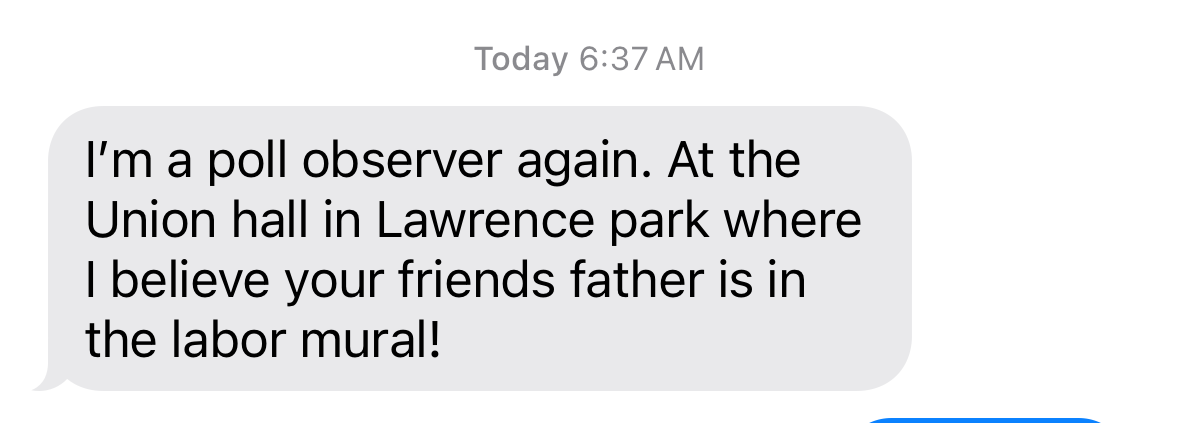
Today a friend in Canada forwarded a message from his friend in Erie, PA.


My dad Ernie Thompson is depicted in a mural about international labor solidarity for women workers. He believed deeply in that cause and it occasioned some of his best work. It is a gorgeous mural and I love the idea that my dad is watching over Election Day there. 

I was up early to vote -- actually I was up at 3am surely because I caught the national anxiety disorder -- and it was fun to go early and see the polling place busy and bright. I chatted with people I know only because it's where I vote and I try to vote in all the elections. We were all glad for democracy. I got a sticker -- I do adore stickers! -- which I will proudly put in my notebook as a reminder of this day's voting. 

I voted Kamala Harris for President, and I'm praying for our country. She wants to be a uniter, and we badly need uniting. As Tiny Tim says in A Christmas Carol, "God bless us, every one!"

Sunday, November 3, 2024

Tao of K-drama: Resolving the "When"

I just finished watching "When the Weather is Fine" for the third time. While some shows might lose their charm on re-watching, so far, every time I've seen this show, I've liked it better than the last time. This time, in addition to appreciating the implications of the "when" in the title, I thoroughly enjoyed the subtleties of the soundtrack. Kwak Jin-eon's "Like a Winter Dream" is so profoundly tender and haunting, it works to set the tone for this show about people carrying unexpressed troubles and longings. 

K-dramas move from unadulterated trauma to restoration of relationships. In this show it is quite clear that Im Eun-seop is the Taoist whose non-coercion permits others to find themselves. And as they find themselves, he grows into himself, pushing himself to say what needs to be said -- for example, to tell his adoptive mother that he loves her. This "non-coercion" is quite extraordinary. I tell people what to do all the time, so I found it remarkable to watch someone not impose on others. Similarly, it is instructive to watch the ways in which non-coercion wins the day. A favorite quote from the Tao on leadership says:

When the Master governs, the people are hardly aware that he exists.

This is the path of Im Eun-seop. Of course, his non-coercion is joined by his love and his intelligence. The show teaches us this by taking us to his bookstore/coffee shop, a place we'd all like to have in our neighborhoods. There, a group a friends meet regularly for their book group. The grandfather of the youngest member grills food for them. The others read quite arcane works on various themes. It is never Im Eun-seop who is driving the reading, but it is his place -- the place he has created -- that offers time and space for such an encounter. 

At the end of the show, two things happen. First, Muk Hae-won returns to the village and sees Im Eun-seop. He asks her how long she is staying -- that is to say, "when" she is leaving. She laughs with joy, obviously not leaving again. And Muk Hae-won is able to write to the friend who had betrayed her trust in high school -- the one she pushed away in the opening scenes with the line "when the weather is fine" -- and say, "The weather is fine." 

We know, then, that we have reached the point of restoration. People have said what needed to be said, made decisions about next steps, and gotten on with the business of living. And no one says, "Wow, Im Eun-eop did a great job helping us all." That is the point, the Tao says. 


Tuesday, October 29, 2024

Tao of K-drama: The Meaning of "When"

I play The New York Times' game Connections almost every day. I'm not that good at it. I like to think that this is because the connections require cultural knowledge that I don't have, like the names of music magazines. But I know that I'm not that quick at making connections, which is why my various research projects -- and certainly my study of K-drama -- have each taken so long. This is a long introduction to the simple fact that I'm watching When the Weather is Fine for the third time and just got the importance of "when." 

The first "when" is spoken by Muk Hae-won to a friend who abused her trust when they were in high school. She says she can't talk to her then but will "when the weather is fine." It is a curious statement. Later, her lover, Im Eun-seop, says to her, "You will be leaving in the spring," ie, "when the weather is fine." Shortly after that, her aunt asks, "Aren't you leaving in the spring?" 

Im Eun-seop, his adoptive family fears, might also leave, but when? His little sister screams at him in fury at the threat of his leaving. When did you start to love me so much, he asks her. "When I was born!" she shouts through her tears. 

The "when" is a marker of uncertainty, the possibility of loss, that one loves from that position of uncertainty. Muk Hae-won thinks to herself, "I wish you [Eun-seop] would say 'stay by my side.'" Im Eun-seop wants to say to his little sister, "I'm not leaving," but can't let the words go. And so the unspoken words come to stand for what might happen "when the weather is fine" or some other fearful moment that hovers in the future. 

"When the Weather is Fine" is not meant to imply "we'll see daffodils," but rather, "When the weather is fine, I will lose you." It is this spoken/unspoken terror that is at the heart of the show. 

Friday, October 25, 2024

Tao of K-drama: Building as Cousin

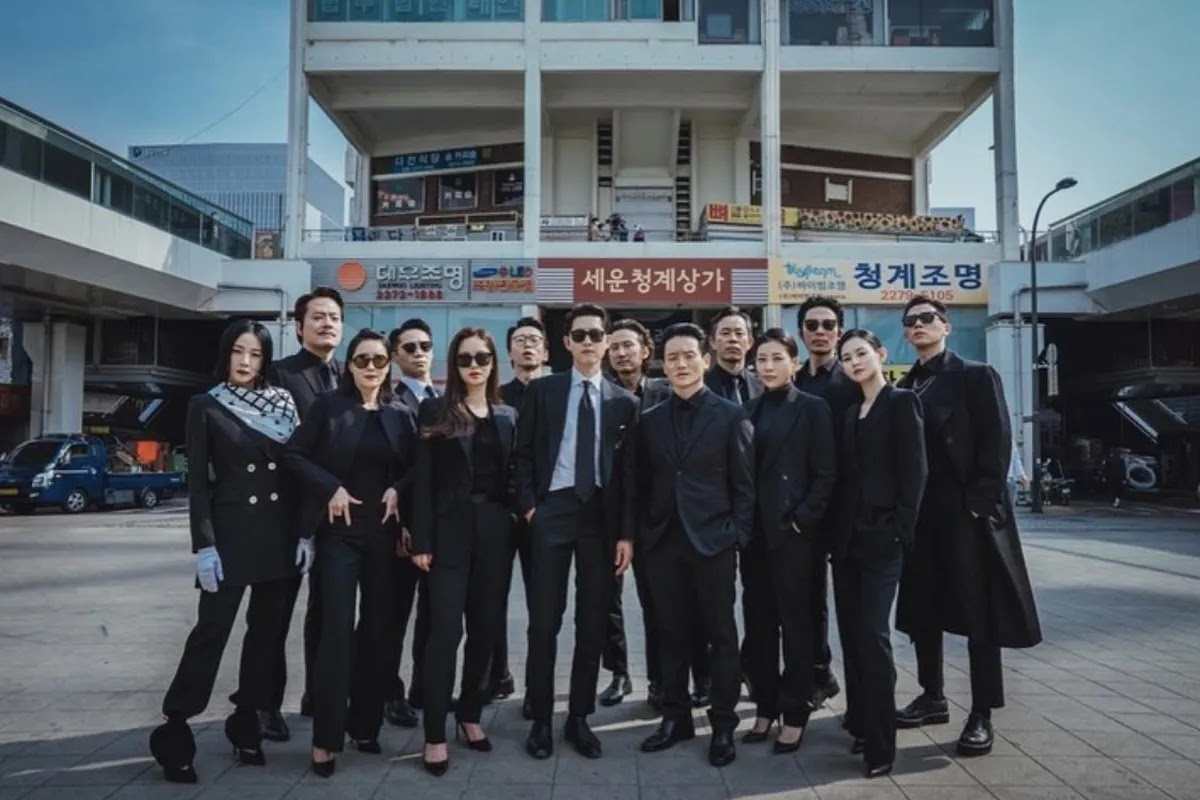
My colleague Margaux Simmons and I share a belief that EVERYTHING on Earth is related, including the soil and the bricks and the toxic waste dumps and bluejays. Everything -- we're all cousins. I wouldn't have thought that a K-drama about a Mafioso would have so much to say about this topic. In fact, I watched because of the fascinating analysis of the building and the show done by Professor Eunju Hwang of Sogang University. I have just finished watching that drama -- Vincenzo -- and there is so much to say about this story of a Korean adoptee who grows up in Italy and, following the murder of his Italian parents, joins the Mafia and rises to consigliere. 

At the top of the list is the building, Geumga, which is a vulnerable and lovable presence throughout the show and a place I had the opportunity to visit with Professor Hwang. It is a real building known as the Sewoon Cheonggye Shopping Center, built in the 1960s as an electronics center. Vincenzo helped a Chinese gangster hide money under the building. Because the gangster has died, Vincenzo wants to get the money as well as a file of incriminating evidence on top business and political leaders, which is also hidden there. The valuables are protected by an elaborate security system and much of the show is about getting around the obstacles for its retrieval. But in that process, what is valuable shifts from gold to cousins, among them, Geumga, which ceases to be seen as a disposable building and is recognized as a treasure. 

The transformation of the inhabitants follows closely on the heels of the transformation in the understanding of the building. The people who live and work there also understood themselves to disposable, easily pushed around, barely making a living in a building that was not meant to endure. Vincenzo -- the gangster with a heart of gold -- impresses them with his ingenuity, fighting skills and unflappable demeanor. They quickly come to count on him to show up at the right moment and change the outcome of events. But this also inspires their own fighting spirit. Over the course of the show, the motley crew emerges as a powerful fighting force, capable of protecting their beloved Vincenzo and their beloved building. A corrupt politician wants to know who stands in his way and they shout, "The Geumga Cassano Family!" Of course, once they identified as part of his family, Vincenzo, who seemingly has an unlimited supply of money, sends them shopping for designer suits, worthy of the Cassano name and image. 

K-drama in general, I have argued, features an arc of restoration. What is the restoration for Vincenzo, who starts out murdering people and ends up murdering people? This is third of many astounding features of this show. Recapper Ren Buenviaje describes a scene in the last episode in which Vincenze seeks the advice of Jeokha, Buddhist monk,who is part of the Geumga Cassano, to think about his future. The monk notes that Vincenzo can't be a Buddha because he has sinned too much. But, he says there is another character in the Buddhist cosmology.  
The monk likens Vincenzo to Vaisravana, who he describes as the scary face at the front of temples that protects Buddha’s ways and all ways human. Vincenzo might not find enlightenment, but he’ll get compliments from Buddha from time to time.
This allows Vincenzo to have a different vision of what he is doing with his life: fighting evil while protecting the innocent. Part of what has been so helpful to the Geumga Cassano family is Vincenzo's explicit naming of evit throughout the show. He names his own actions as evil, and is careful to get consent from the growing team for participating. The naming has helped to solidify their own sense of harms and perfidies of the opposition, pharmaceutical chaebols, loosely modeled on the Sackler family and its promotion of oxycontin. At one point, an intelligence agent who is undercover at Geumga to see what Vincenzo is up to, says in adoration, "He is not Mafia -- he is Che Guevara!" For all those of us who grew up admiring the feats of the Commandante, that is just a perfect moment. 

I think we shy away from naming Evil -- Vincenzo calls us to task. The last word of the show is that evil is vehement and vast. 

But we have also learned that we have the capacity to fight back -- and win -- protecting all who are considerable "disposable,." In these challenging times, that is an important message. And we have learned much about our cousins -- buildings, evil companies, poisons promoted as medicines, designer clothes, people who can stand up to injustice, people who love each other and one another. The list of cousins is, to riff on the closing of Vincenzo, encyclopedic and precious.